
Table of Contents
- Key takeaways
- When does your buyer actually start looking?
- One deal, four searchers
- Why your keyword tool shows nothing worth chasing
- Why the head terms are a trap
- Nobody buys a £500k conference in one click
- How do you measure a channel that pays out in month nine?
- What about AI search? Do we need to worry about ChatGPT?
- The lag is the advantage
- Where to start
I pulled the Search Console on an event services website recently.
Last ninety days: sixty-eight event-related search terms. Three thousand four hundred and forty impressions. Positions mostly between six and twenty, so page one and page two.
One click.
One. Out of 3,440.
The obvious conclusion is that the rankings need work. They don’t. The biggest term in the whole set was sitting at position six. Page one, top half, on the term with the most impressions by a mile. And still nobody clicked.
Because of what it was ranking for. Terms like “event and occasion keywords” and “general event space keywords”. Those aren’t buyers. Those are marketers hunting for keyword lists to put in a spreadsheet. Not one of them was ever going to book anything.
That’s the thing about SEO in this industry. When it fails, it almost never looks like failure. It looks like a report full of green.
I’ve spent enough years on the delivery side to know how this feels from your chair. You’re paying for a channel, the numbers go up, and the phone doesn’t ring differently. So you conclude SEO doesn’t work for a business like yours.
It does. But almost nobody runs it correctly, because almost nobody running it has sat in a production office watching a six-figure deal crawl through its ninth week of silence.
Key takeaways
- Your buyer is searching across the whole process, not just at the end. Early education, mid-stage comparison, late validation. Most event businesses build for the last one only, then wonder why they never make the shortlist.
- One deal has four or more searchers, each entering at a different depth. The marketing lead, the technical lead, procurement and the MD run separate research with separate questions and separate levels of knowledge.
- Head terms are the most expensive and least efficient way in. They’re contested by everyone, they cost a fortune in paid, and a single click on one has never once closed a six-figure event.
- Keyword tools are blind here by design. They report past search behaviour, not future market requirements, so the terms that matter most in this niche get rounded to zero.
- The lag everyone complains about is the actual advantage. If your sale takes months, a channel that compounds over months is synchronised to it, and it makes every paid campaign you run afterwards cheaper.
When does your buyer actually start looking?
Far earlier than most event businesses assume, and far earlier than their website is built for.
6sense’s 2025 B2B Buyer Experience Report, published in November 2025 off a survey of more than 4,000 buyers across North America, EMEA and Asia-Pacific, puts the split between independent research and seller engagement at roughly 60/40. Buyers averaged sixteen interactions per person with the vendor that eventually won. The average buying cycle ran 10.1 months.
And the number that should stop you dead: 94% of buying groups had already ranked a preferred vendor before they contacted anyone at all. Around 80% went on to buy from that preliminary favourite.
Read that again, because it reframes the entire job. By the time a buyer speaks to you, the shortlist is largely set and you are either on it or you are arguing with a decision that has already been made. The work that puts you on it happens months earlier, in private, in browser tabs nobody will ever attribute.
In event services that pattern gets amplified, because the purchase is high-risk and highly visible internally. Nobody wants to be the person who chose the supplier that dropped the flagship conference.
Here’s where I think most of the industry gets this wrong in both directions.
One camp assumes search only matters at the end, when someone is ready to buy. So they build three service pages, target the obvious commercial terms, and treat everything else as a waste. The other camp assumes search is a discovery channel only, publishes endless top-of-funnel content, and never gives a serious buyer anything to validate against.
Both are half right, which is worse than being wrong.
Search runs the entire length of this process. Someone scoping a first-ever hybrid conference searches to learn what they don’t know. Someone six weeks in searches to compare approaches and pressure-test a supplier’s claims. Someone in week twenty searches your company name to check you’re real before putting you in front of their board.
Same channel. Three completely different jobs. And with a buying committee, all three are happening at once, run by different people who have never spoken to you.
One deal, four searchers
This is the part that quietly kills more event deals than any ranking problem.
A six-figure programme isn’t bought by a person. It’s bought by a committee that never meets in one room.
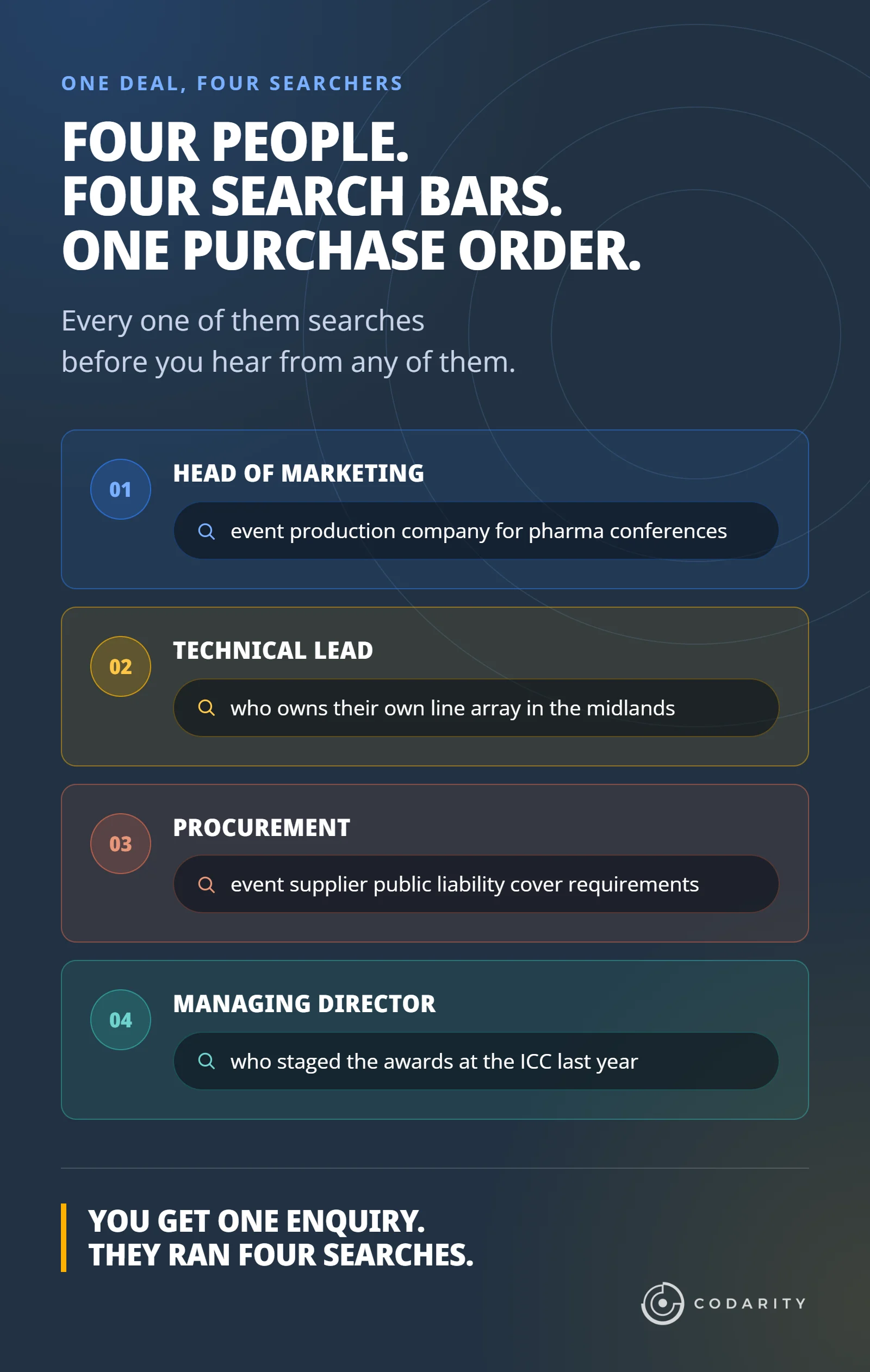
The Head of Marketing is searching for capability and specialism. Can they do multi-camera. Have they worked in our sector. What’s their creative range.
Procurement is searching for credentials, insurance limits, financial stability, risk. Completely different language, completely different pages.
The technical lead is searching for kit, spec and practical detail. They want to know what you own versus what you sub-hire, and whether you’ve done this scale before.
And the MD, at some point, searches your company name and reads whatever comes back. Reputation, proof, whether you look like the sort of firm that turns up.
Four people. Four question sets. One purchase order.
Now layer the funnel on top, because this is the bit that matters. Those four aren’t at the same stage. Your technical lead may know exactly what they need and be validating. Your Head of Marketing might be three weeks into learning the category. Procurement enters cold in month six and starts from nothing.
So you don’t need coverage at one stage of the funnel. You need coverage at every stage, several times over, for people with wildly different starting knowledge. That is the shape how SEO works inside EEPS is built around, and it is why a three-page service site cannot do this job however well it ranks.
Most event services websites answer the capability question beautifully and the other three not at all. Then the deal stalls in procurement and everyone blames the price.
Why your keyword tool shows nothing worth chasing
Run this industry through any keyword tool and you’ll get a thin, disappointing list. A few hundred searches a month on the obvious service terms, then nothing.
That’s not an absence of demand. It’s an absence of measurement.
Keyword tools report what people have already searched for. They cannot report what your market is about to need. In a niche this small, with buying cycles this long, that gap is where the whole opportunity lives.
We learned this the hard way about three years ago. A client wanted to go heavily into sustainability content. We ran every variation through the tools. Event sustainability, sustainable events, green event planning. Zero volume across the board, every tool, no exceptions. On paper it was a terrible idea.
Those articles now bring in thousands of monthly visits from exactly the right people. Not researchers or browsers. Buyers with sustainability requirements in their tender documents, looking for an agency that already understands them.
We wrote about that in more detail, and the underlying principle holds beyond sustainability. Think about what your buyer actually types in the early weeks. How to brief an AV supplier for a multi-stage conference. Who carries the risk on a load-in. What should be itemised in a staging quote. Whether a hybrid build is worth the production cost for two hundred remote delegates.
None of those register properly in a keyword tool. The monthly volume sits below the reporting threshold, so it gets rounded to zero.
But every person typing one of those has a live budget and an unsolved problem. The volume is low because the market is small. The value per search is enormous, because only so many organisations commission six-figure event programmes, and each one is a client you’d want.
Generalist agencies won’t build for those terms. They can’t. Their model needs a forecastable number in a deck before work starts, and you cannot forecast off zero. So they sell you the terms that do have volume, which are the terms your competitors’ marketing departments are searching.
You don’t have that problem. You know what your buyer is worried about, because you’ve been in the room when they said it out loud.
Why the head terms are a trap
There’s a second reason the long tail matters, and it’s pure economics.
Everyone in your category wants the same handful of head terms. Corporate event production. Conference production company. Technical event production agency. They’re the terms that show up in every strategy deck because they’re the only ones with visible volume.
Which means they’re contested by every competitor you have, plus a layer of national agencies with deeper pockets.
Here’s what that costs, from our own account data rather than a published estimate. On those head terms, the average top-of-page bid at last check was £18.45 a click. Absolute top of page was £26.73. And because nobody converts on one visit, you’re paying that repeatedly, across four people, over nine months, for one opportunity that may not even close.
Run that maths honestly. Forty-odd touchpoints, some meaningful share of them paid, at twenty-odd pounds each, for a single opportunity. It’s survivable as one line in a system that also owns its organic ground. It’s ruinous as a strategy on its own.
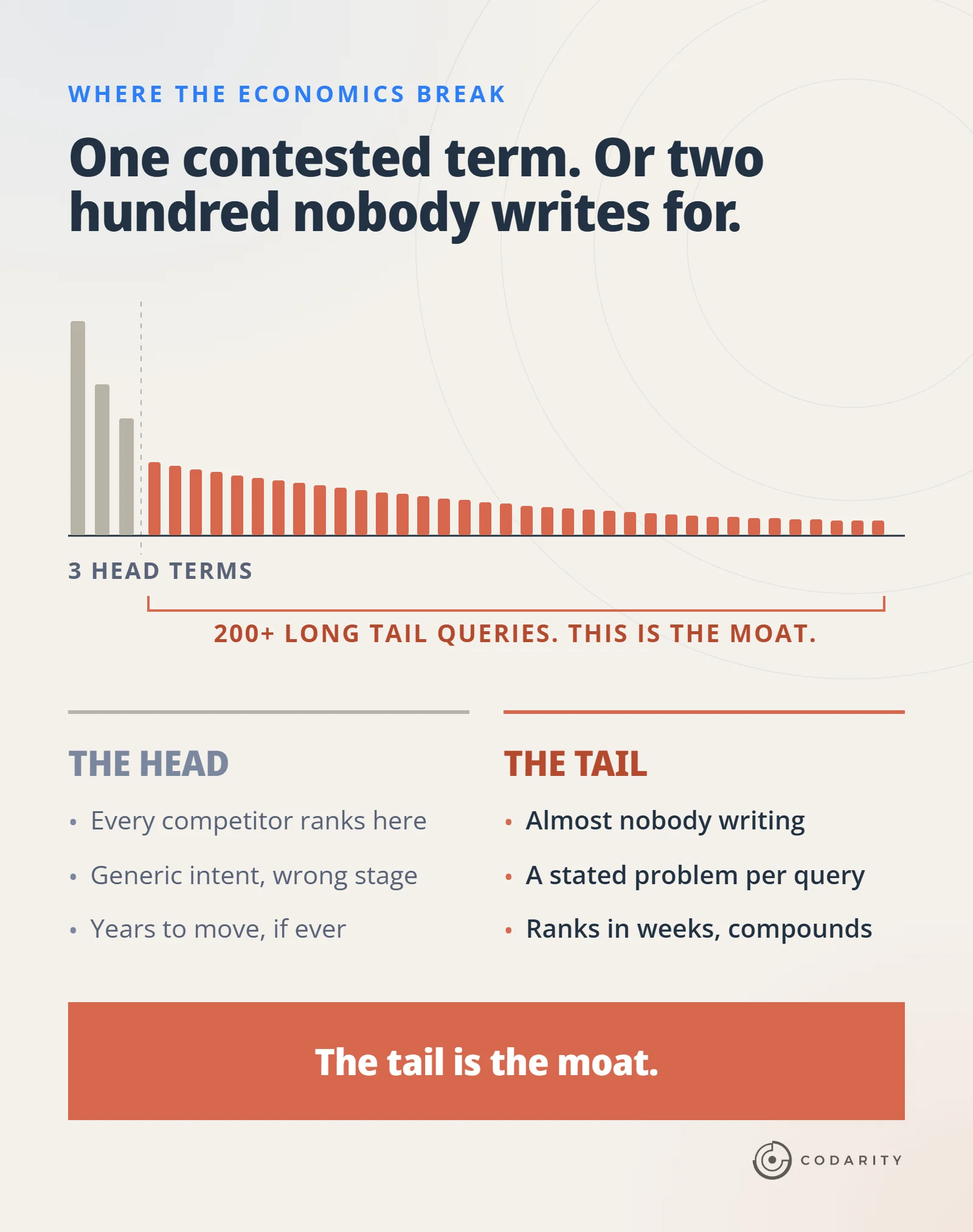
The long tail inverts it. Hundreds of specific, low-competition queries, each one cheap or free to win, each one signalling a much clearer problem than a head term ever could. Individually they look insignificant. Collectively they become something a competitor cannot simply outbid you for, because there’s no auction to enter and no shortcut to earning it.
That’s the moat. Not one ranking. Hundreds of small, unglamorous positions that took years to accumulate and would take a rival years to replicate. Which is the same mechanism behind building a competitive moat through trend positioning: the advantage isn’t the content, it’s the head start nobody can buy back.
Nobody buys a £500k conference in one click
Nobody has ever committed half a million pounds to a supplier they met ninety seconds ago.
Picture it honestly.
A senior stakeholder searches “technical event production agency”, clicks the third result, reads a page, and commits half a million pounds of budget and their professional reputation to a supplier they’ve known for ninety seconds.
It has never happened. It will never happen.
Yet that is precisely the model most reporting is built on. One click, one source, one conversion. It’s how ad platforms are designed to report, it’s how most CRMs record a lead, and it is entirely disconnected from how your industry actually buys.
Which matters, because that reporting decides where your budget goes next year.
How do you measure a channel that pays out in month nine?
This is where it usually falls apart, and it isn’t a marketing problem. It’s arithmetic.
Published research puts event planning and management services at 14.8 touchpoints per sale. That figure gets quoted a lot, including by us. But it’s an average across the whole spread of deal sizes, and it best represents smaller, single-decision work. A £4,000 AV hire is not a £500,000 conference.
Scale it up and the count climbs, because each additional stakeholder brings their own research loop. Remember that 6sense measured sixteen interactions per person with the winning vendor — per person, not per deal. Put four stakeholders through their own loop and the arithmetic runs past forty before you’ve counted a single thing the CRM missed.
Our own observed range on six-figure, committee-led event programmes is 35 to 45 touchpoints. To be clear about what that number is: it’s what we see in our client data, not a published finding. The events-specific research doesn’t segment by deal size, so nobody has published a figure for this. Treat it as a working assumption you should test against your own pipeline, not a citable statistic.
Now hold that against how it gets recorded.
Forty-odd interactions. Nine months. Four people. And your CRM logs one source, the last one, usually a branded search or a direct visit from someone who already knew your name.
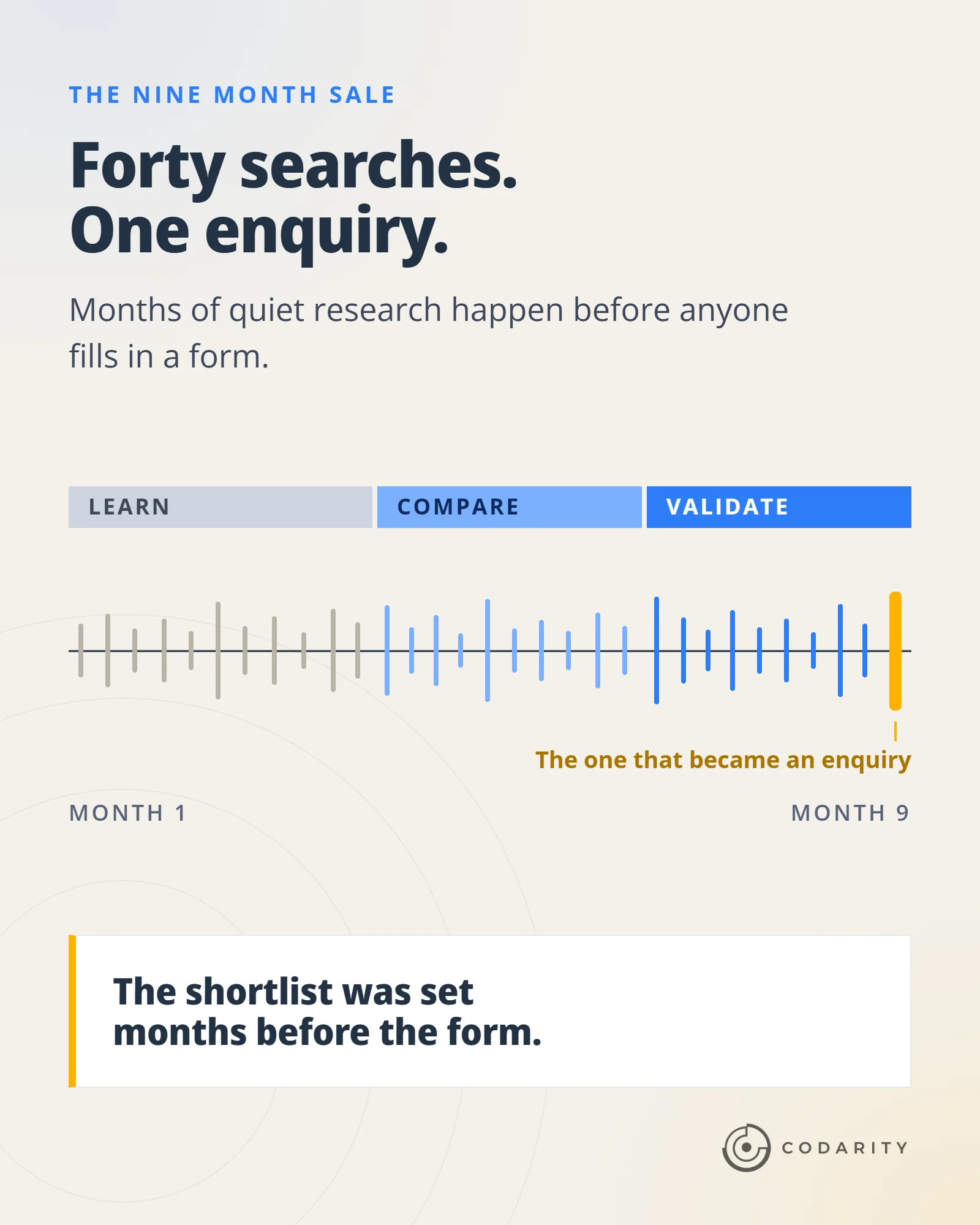
So the win appears as Source: Unknown, or gets credited to whichever channel was standing nearest the finish line. We’ve traced one of these end to end: a client closed £180,000 on a deal the analytics never saw coming. And the work that created the demand in month two gets cut in the next budget review, because on paper it produced nothing.
That’s not a tracking inconvenience. That’s how good channels get killed.
Fixing it needs first-party tracking for long cycles, built for the length of your actual sales cycle rather than a thirty-day attribution window borrowed from ecommerce. In practice that means holding onto source data across every form and tool a nine-month journey touches — the mechanics of universal attribution tracking, where most of these journeys quietly lose their origin. It’s the least glamorous infrastructure in the business and the one that decides whether every other decision you make is informed or guessed.
What about AI search? Do we need to worry about ChatGPT?
Yes, and not for the reason most people think.
That private research phase just moved again. In the same 6sense study, 94% of buyers said they used large language models to synthesise their research. They open an assistant, ask it to explain the category, compare approaches and suggest who to talk to. That happens even earlier than search and even more privately. You’re either in the answer or you aren’t, and you’ll never see the query.
That isn’t a general-population trend arriving late to your industry. When we looked at the data, corporate event buyers were AI power users — using these tools 58% more than the average, and layering specialised ones for different research phases. Your buyer got here before your website did. It’s worth understanding how AI chooses which event company wins, because the selection is already happening whether or not you can see it.
The mechanics are genuinely different, and this is where most content fails.
These systems retrieve passages, not pages. They chunk your article, match the chunks against the question, and quote what fits. A section that only makes sense after reading the three above it will never get extracted. It gets skipped, silently.
What gets pulled and cited is content that is specific, self-contained and checkable. Real numbers. Named sources. Dates. Claims that could be proven wrong.
Which is the same content a procurement lead in month three actually wants to read. Convenient, that.
The unglamorous basics still earn their place, too. Keyword in the H1, keyword in the title tag, clear headings. They just do a different job now. They tell the machine what a passage is about, so it gets retrieved for the right question and credited to the right company. That matters more than ever when you’ve spent a decade in one industry and want to be understood as a specialist rather than filed under general marketing.
The lag is the advantage
Every objection to SEO in event services is a timing objection wearing a disguise. It takes too long. We need bookings this quarter. We tried it for six months and stopped.
So here’s the reframe, and it’s the whole argument.
Your sale takes months regardless. Nothing you do to your marketing changes that. It’s the physics of a considered, committee-led, high-risk purchase.
A channel that takes months to mature is therefore not slow. It’s the only one running at the same speed as the thing it’s meant to influence. Paid search stops the day the card stops working. A position earned this year is still earning next year, and it makes every ad you run cheaper, because the name is already familiar when the ad appears.
We started with Eclipse Global in 2018. Search and content first: SEO, website copy, and the digital PR groundwork that made them findable and credible to buyers researching in private. Unglamorous, compounding work.
Only later did we build the demand engine on top of it. One six-month paid push added £744,000 at a 38x average return. That number gets quoted, and it’s real, but it’s not the interesting part. The interesting part is that the push worked as well as it did because six years of authority had already been banked. The audience knew the name before the ad ever loaded.
They were a £7 to 8 million agency when we started. They’re around £30 million now, with millions in monthly pipeline and twelve months of forward visibility. That’s seven years with Eclipse Global, laid out in full.
To be straight about it: no single campaign did that, and we’d never claim otherwise. Eclipse’s growth belongs to Eclipse and a genuinely world-class team. What compounded over seven years was the infrastructure underneath it.
Most businesses stop at month five. That’s the entire difference.
Where to start
If your deals take nine months and your marketing gets judged every thirty days, the reporting will keep telling you the wrong story, and you’ll keep cutting the things that work.
The fix starts with knowing which of your buyers you’re currently invisible to, and at which point in their process.
The EEPS Assessment maps exactly that. Where your authority stands today, which of your buying committee your site actually speaks to, and what to build first. It’s the front door to the Evergreen Event Profit System.
Start with the EEPS Assessment
Not ready to talk? Take the Growth Scorecard. Two minutes, and you’ll know where you stand across all four pillars.