
Table of Contents
The room you win in is about 5% of the decision. Here’s where the other 95% happens, and why you never see the briefs you lose.
A managing director said this to me on a call recently, as an aside, halfway through explaining something else entirely.
“We win when we’re in the room. The problem is getting in the room.”
He meant it as a complaint about logistics. Introductions, invitations, being on someone’s list. It isn’t a logistics problem. It’s the most accurate one-sentence description of a growth ceiling I’ve heard from anyone in this industry.
And the half of that sentence worth paying attention to is the first one.
Key takeaways
- A strong close rate tells you where the problem is, not that you don’t have one. If everything downstream of the invitation works, the constraint sits upstream of it.
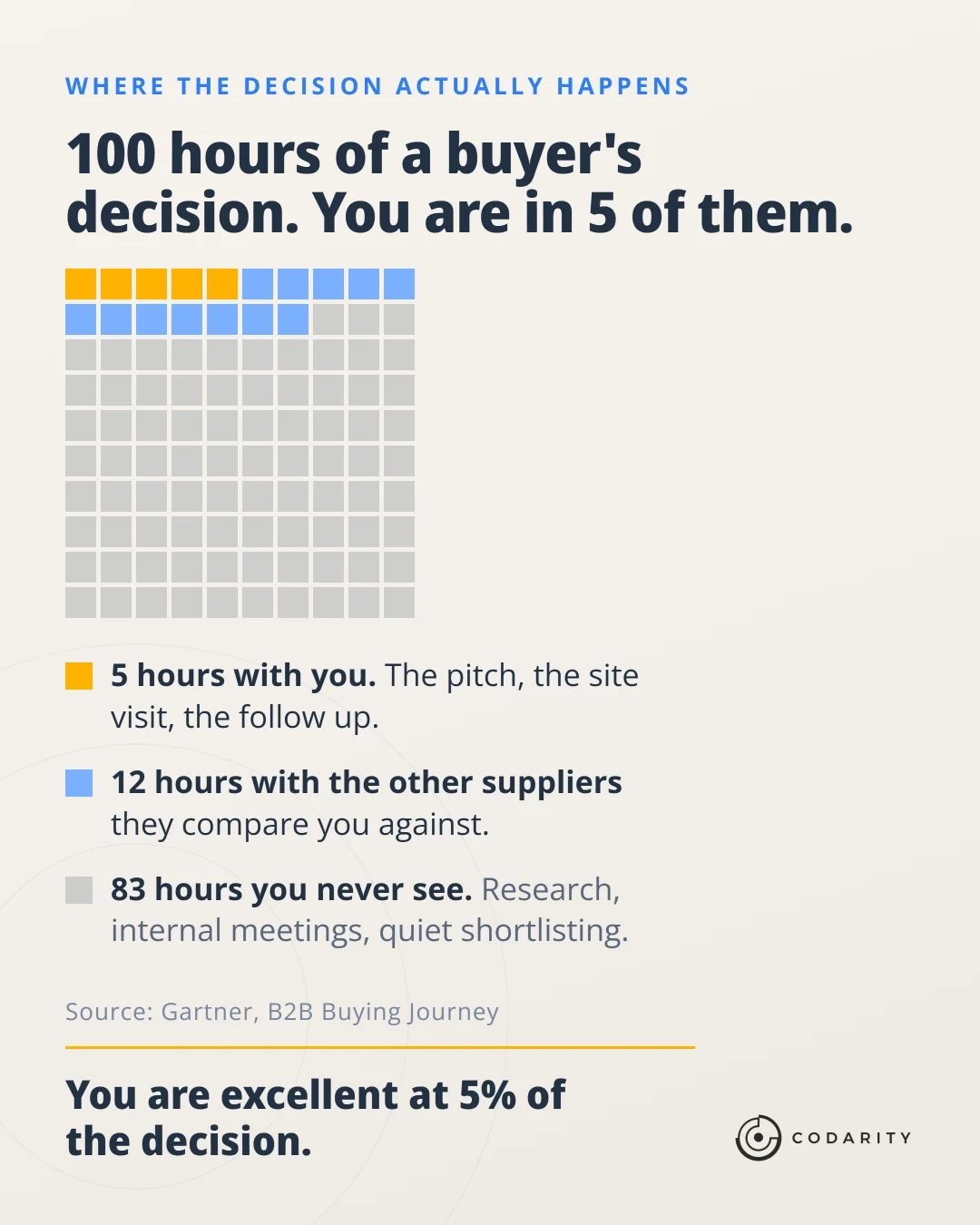
- The room is roughly 5% of the decision. Gartner’s research puts supplier meetings at 17% of total buying time, and 5 to 6% for any single supplier when several are being compared.
- You can only lose deals you were invited to. The unseen column is the bigger one, and nothing in your business reports on it.
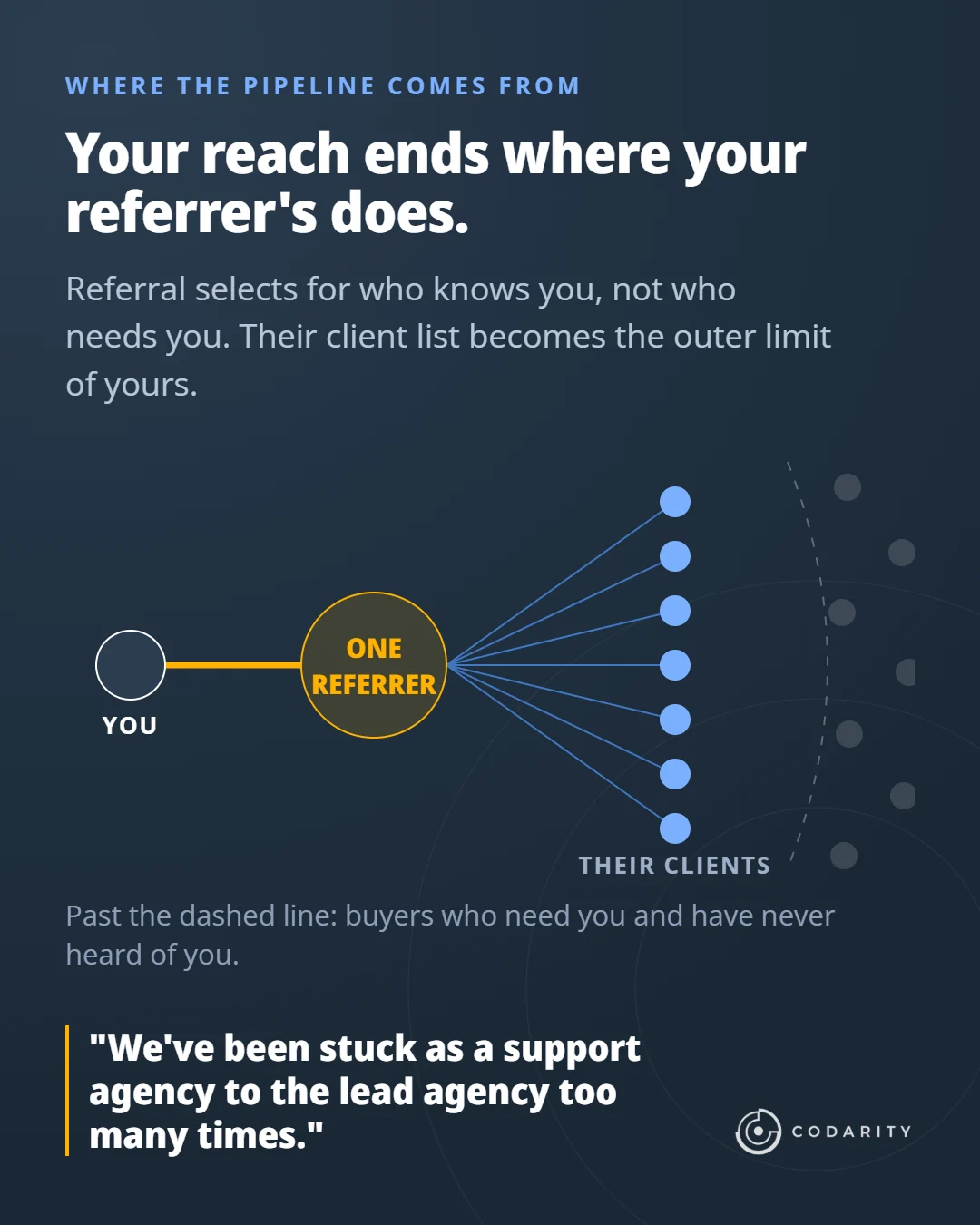
- Referrals select for who knows you, not who needs you. Your pipeline inherits the shape of your network, and your network stopped growing around the time you got busy.
- Unpredictable revenue blocks hiring, which blocks capacity, which blocks the larger job. By that point it has stopped being a marketing problem.
What does a high close rate actually tell you?
If you win most of what you pitch, a lot of things are already working.
Your product is right. Your pricing sits where it should. Your team is credible in a room full of people who can tell the difference. Your references check out and your delivery holds up. Those are the expensive, slow, painful things to fix, and you don’t need to fix any of them.
Most operators read that as reassurance. It isn’t. It’s a location.
A strong close rate tells you precisely where the problem isn’t, which by elimination tells you where it is. Everything after the invitation works. So the constraint sits before it.
Then there’s the question of how much of the decision that room actually represents, and the answer is smaller than almost anyone assumes. Gartner’s research on B2B buying found that buyers spend around 17% of their total purchase time meeting with suppliers at all. When they’re comparing several, any one supplier gets roughly 5 to 6% of their time.
Five per cent.
That’s the room. You are excellent at 5% of the process, and you have built your entire commercial strategy on being excellent at it.
You can only lose what you were invited to
Your loss column only contains deals you were actually in, so a strong win rate is measured against a denominator that excludes every brief you never saw.
“We don’t lose many.” I hear it constantly, and it’s usually true. It’s also close to meaningless, for exactly that reason.
A brief that went to three firms where you weren’t one of them doesn’t show up anywhere. A budget committed to a name someone on the committee already trusted doesn’t show up. A procurement shortlist drawn up from a search, a recommendation and a conference badge from two years ago doesn’t show up. There is no record anywhere in your business of a pitch you were never asked to make.
So the biggest number you have is the one nothing reports on. Not lost deals. Unseen ones.
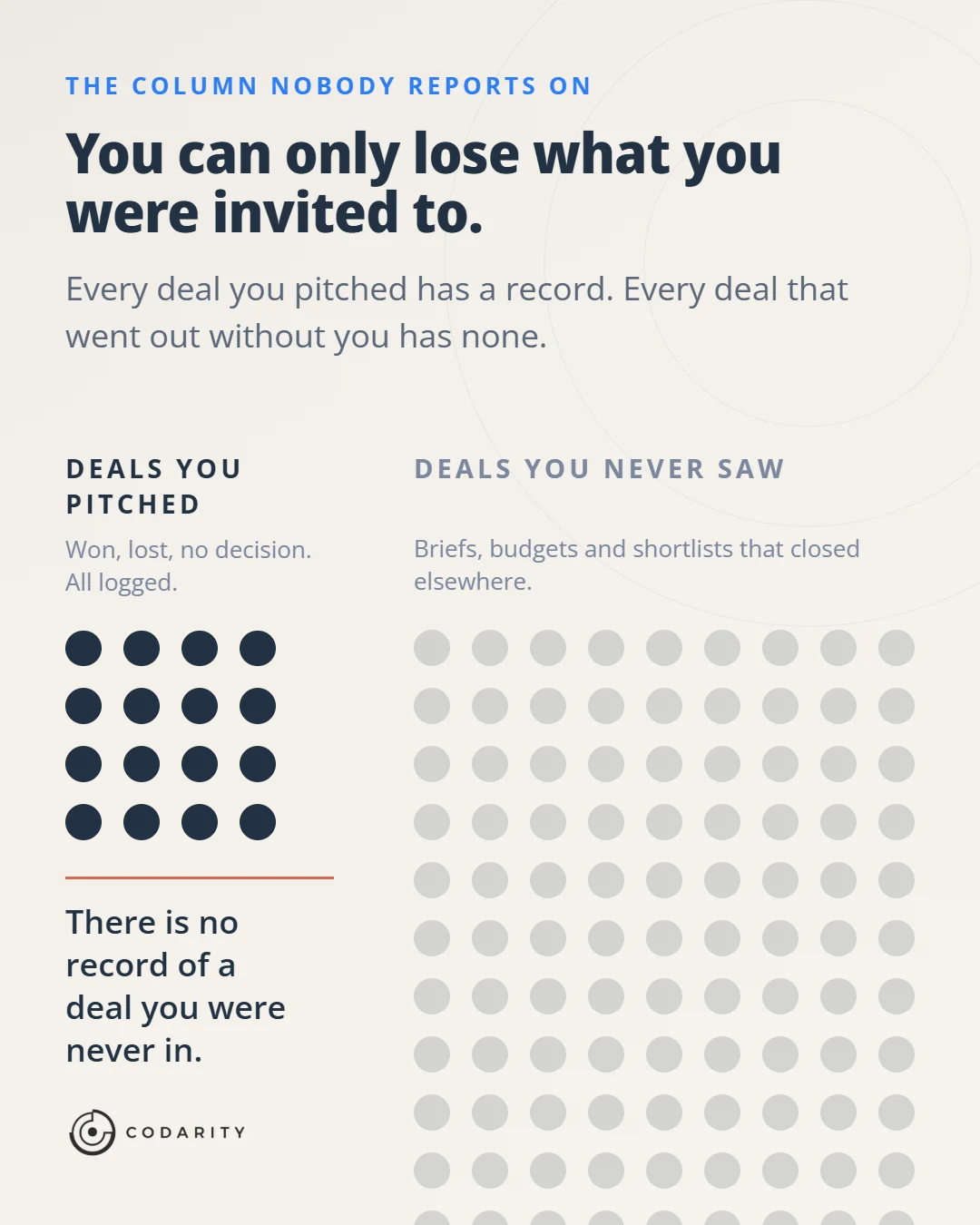
And the more your growth has come through relationships, the larger that number gets, because your visibility is bounded by your network rather than by your market. Those two things used to be roughly the same size. They aren’t any more.
Why referrals quietly set your ceiling
Referrals are the best lead source you will ever have. They’re also the one you control least.
They convert better than anything else. They arrive pre-vetted, with the trust already transferred. They cost nothing. If someone offered you a channel with those numbers you’d take it in a heartbeat, and you’d be right to.
They also select for who knows you, rather than who needs you.
That distinction is the entire ceiling. The shape of your pipeline is set by the shape of your network, and your network stopped changing at roughly the point you got busy enough to stop going to things.
The MD I quoted at the top had a second line, later in the same call.
“We’ve been stuck as a support agency to the lead agency too many times, and we want to be the lead agency.”
That’s the ceiling, and the ambition, in one sentence. You don’t simply depend on the referrer. You inherit them. Their growth rate becomes your growth rate. Their client list becomes the outer boundary of yours. Their good year is your good year, and their vendor review is your bad quarter.
Finance has a name for this. Client concentration risk. In professional services, a single client at 10% or more of revenue already meets the definition, and the agency consultant David C. Baker makes the sharpest point about it: the real danger isn’t that you’ll do bad work. It’s that they get acquired, or a new finance director runs a vendor review, and not one part of that process is anything you can influence.
The same logic applies to a referrer, arguably more so. At least a client relationship is contractual.
Then it stops being a marketing problem at all. Another line, from a different call, put the trap better than any consultant would:
“I can’t hire ahead of revenue I can’t predict, so I never hire, so I never grow.”
Unforecastable revenue means you don’t build capacity. No capacity means you can’t take the larger job when it finally appears, so you turn it down or you take it and it hurts. By then the ceiling has moved from marketing into operations, and it’s much harder to shift from there.
Where did the room go?
Getting in the room used to mean what you’d expect. Industry events, relationships, sitting on a roster, knowing someone who knew someone.
That still works. It also still has the ceiling described above.
What changed is where the shortlist gets built. Gartner describes B2B buying not as a linear funnel but as a set of jobs buyers keep looping back through: working out they have a problem, exploring what’s out there, deciding what they actually need, choosing between suppliers, checking they’ve got it right, and getting everyone internally to agree.
Almost all of that looping happens with no supplier present.
By the time you’re invited, the requirements are written, the shortlist is short, and a significant part of the deciding has already happened. You’re not being evaluated so much as confirmed.
Getting in the room now means existing during the part of the process you aren’t in. Which is a different problem to the one most event businesses think they have, and it’s the reason the buying cycle itself deserves more attention than it usually gets.
So what actually changes it?
What changes it is distribution that doesn’t depend on who you already know.
Not more marketing. That’s the reflex answer, and it’s why so many event businesses have a bad agency story they can tell you in detail. Three things carry the alternative.
Be findable while they’re researching, not just when they’re enquiring. Most event businesses have a website built to answer questions from people who have already decided to make contact. That’s a brochure. It does nothing at all during the 95%, and nothing at all for reaching buyers who don’t know you.
Be legible to a stranger. A referral arrives with the vouching already done. A stranger arrives with none of it, so everything the referrer would have said about you now has to be evident without them. This is what positioning is actually for.
It’s also why full service, on its own, works against you. Not because breadth is a problem. Plenty of the best firms in this industry genuinely do everything, and do it properly. The problem is that full service as a standalone claim tells a stranger nothing at all. It’s the least useful sentence you can offer someone trying to work out whether you’re right for one specific job.
Full service within a category is a completely different proposition. Full service for sustainability-led programmes. Full service for product launches. Full service for technically complex builds. Same breadth, same capability, but now a stranger knows what you’re for. You give up nothing you actually do, and you become findable for the thing you’re best at.
Be able to see it working. If you can’t attribute it, you’ll cut it, usually in month five, usually right before it starts compounding.
One caution, because the obvious next move is normally the wrong one. Gartner surveyed 632 B2B buyers and found that 73% actively avoid suppliers who send them irrelevant outreach. Volume is not the cure for invisibility. Relevance is. Doing more of the wrong thing at these people makes you less visible, not more.
The goal isn’t fewer referrals
Referrals aren’t the enemy here, and this isn’t an argument for replacing them. Any agency that tells you to walk away from the thing that built your business should be shown the door on the spot.
The goal isn’t fewer referrals. It’s referrals plus something you own.
And it’s worth being clear about who this actually affects, because it isn’t the businesses that are bad at relationships. It’s the ones that were so good at them they never needed anything else. This industry runs on trust, reputation and who turned up when it mattered at two in the morning. That’s mostly a good thing, and I’d rather work in one that does than one that doesn’t.
It just has a limit nobody warns you about. You tend to find it at precisely the moment you’re trying to grow past it.
Where to start
You’re already excellent at the 5%. That part is solved, and it took years.
The question is what’s happening in the other 95%, and whether you can currently see any of it.
The EEPS Assessment maps exactly that. Which of your buyers can’t find you, where in their process you disappear, and what to build first. What it looks like once it compounds is seven years with Eclipse Global.
Start with the EEPS Assessment
Not ready to talk? Take the Growth Scorecard. Two minutes, and you’ll know where you stand across all four pillars.